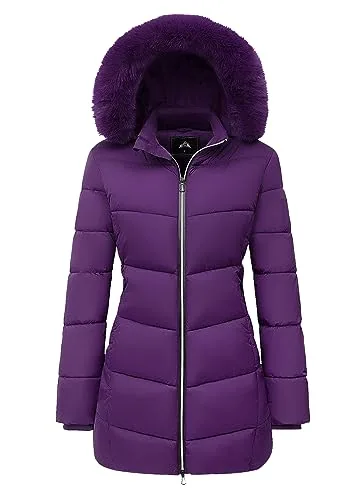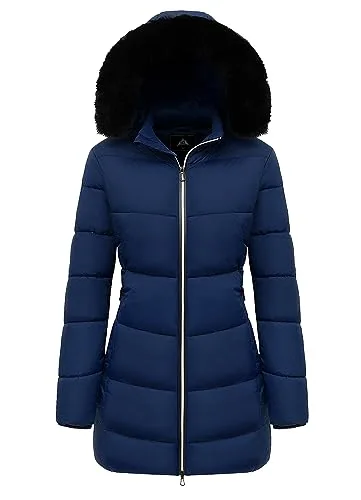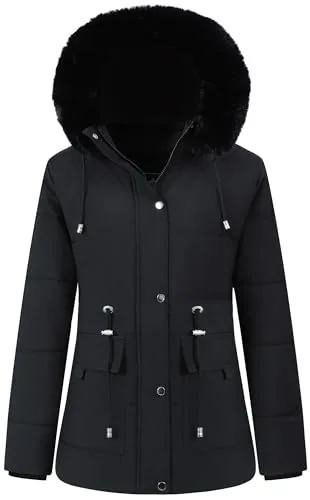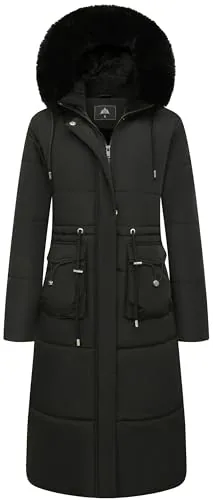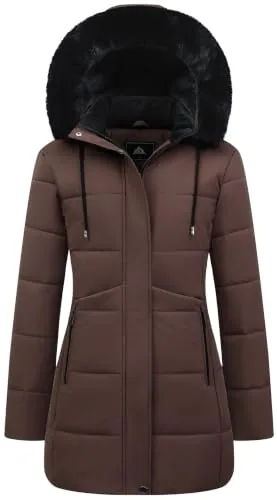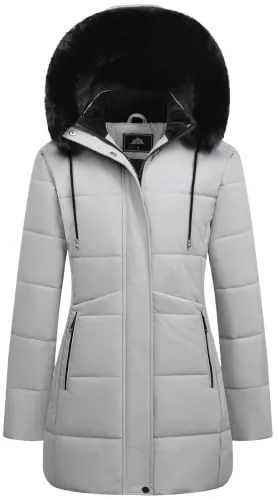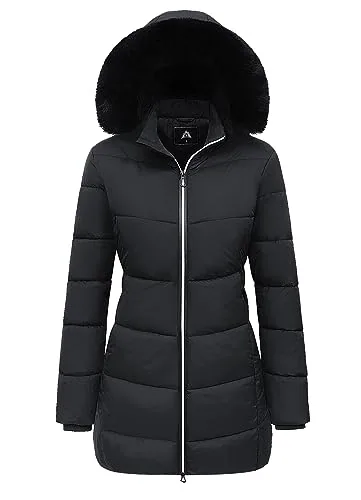
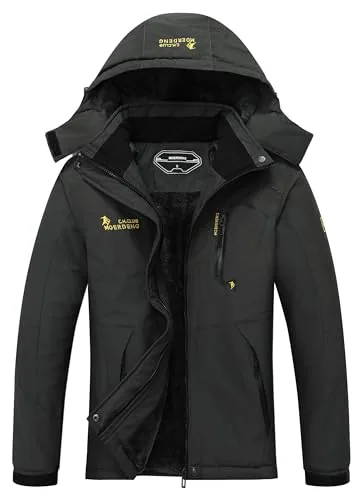
Long Hooded Puffer Jacket, Black
4.5 out of 5 from 4,281 ratings
$39.99
See the detailsReading the label
Fibre content is regulated down to the five percent line. Waterproof, windproof and breathable are not regulated at all. Here is the federal rule quoted word for word, and what it means when you are reading a jacket page rather than a law.
15 minute read · sources read 5 September 2026
4.5 out of 5 from 4,281 ratings
$39.99
See the details4.5 out of 5 from 4,281 ratings
$23.99
4.5 out of 5 from 4,281 ratings
$23.99
4.5 out of 5 from 4,281 ratings
$23.99
A winter jacket on sale in the United States carries a label because a federal statute demands one. The statute is the Textile Fiber Products Identification Act, and the working detail lives in the Commission's rules under it, in Part 303 of Title 16 of the Code of Federal Regulations. Those rules are short, specific and surprisingly readable, and they answer a question most shoppers never think to ask: what is the label obliged to tell me, and what is it free to leave out?
In one line: the rules cover the fibres in a garment and the firm behind it. They say nothing about warmth, rain or how long the jacket lasts. That division explains most of the confusion in the outerwear aisle.
The first thing a label must do is name the fibres, and it must name them in a fixed order rather than in the order that flatters the garment.
...shall appear in order of predominance by weight with any percentage of fiber or fibers required to be designated as “other fiber” or “other fibers” appearing last.
16 CFR 303.3, Fibers present in amounts of less than 5 percent, read 5 September 2026
Predominance by weight means the biggest share comes first. If a jacket shell is listed as polyester before anything else, polyester is the majority of that shell by weight. So a label reading “100% Polyester” on a winter jacket is not a disappointment. It is the shell doing the job a shell does, and it tells you how the fabric behaves with heat, water and abrasion.
It also tells you something about care, which is the subject of a separate guide: polyester tolerates a cool machine wash and hates a hot iron.
Small amounts of a fibre are treated differently, and the rule draws the line at five percent of total fibre weight.
...no fiber present in the amount of less than 5 percent of the total fiber weight shall be designated by its generic name or fiber trademark in disclosing the constituent fibers in required information, but shall be designated as “other fiber.”
16 CFR 303.3(a), read 5 September 2026
The point of that line is to stop a garment being sold on a trace. A jacket with two percent of an expensive fibre cannot put that fibre's name on the label as though it mattered, because at two percent it does not. The rule then makes one sensible exception, for a fibre that does a real job at a small percentage, and gives the example of four percent spandex in an acetate fabric: stretch is a function, not a decoration.
For a winter jacket this matters most with elastic panels at the cuff and the hem. If you see “other fiber” on a label, it is not a mystery ingredient. It is the rule doing its job.
An insulated jacket is really two or three garments stitched together, and the rules recognise it.
In disclosing the required information as to textile fiber products, the fiber content of any linings, interlinings, fillings, or paddings shall be set forth separately and distinctly if such linings, interlinings, fillings, or paddings are incorporated in the product for warmth rather than for structural purposes...
16 CFR 303.22, Products containing linings, interlinings, fillings, and paddings, read 5 September 2026
Read the condition: for warmth rather than for structural purposes. A lining that is there to make the jacket hang properly can be folded into the general statement. A lining or a fill that is there to keep you warm has to be declared on its own, because it is part of what you are buying the jacket for.
This is the single most useful sentence in Part 303 for anyone shopping for outerwear. It means a well made label for an insulated coat has more than one line on it: a shell content, a lining content, and a fill content. When you only see one line, you are looking at a shell.
Across this catalogue the picture looks like this, counted at the last update:
| Bench | Pages | Shell content stated in the description | Fleece lining stated | Faux fur trim stated |
|---|---|---|---|---|
| Ski & Snowboard Jackets | 48 | 0 | 0 | 0 |
| Winter Coats | 44 | 0 | 0 | 0 |
| Long Down Coats | 69 | 0 | 59 | 59 |
| Puffer Jackets | 16 | 0 | 11 | 11 |
| Rain & Softshell Jackets | 21 | 21 | 0 | 0 |
| Hiking Jackets | 16 | 0 | 0 | 0 |
The column that matters is the third one. Where the maker states the shell content in the description we print it on the jacket page. Where the description is silent, our page is silent too, and the label on the garment itself is the place to look.
Two more rules close two obvious loopholes. The first governs the strongest claim a label can make about content.
Where a textile fiber product or part thereof is comprised wholly of one fiber, other than any fiber ornamentation, decoration, elastic, or trimming as to which fiber content disclosure is not required, either the word All or the term 100% may be used in labeling, together with the correct generic name of the fiber and any qualifying phrase, when required...
16 CFR 303.27, Use of the term “All” or “100%”, read 5 September 2026
So “100% Polyester” is a claim with a definition behind it, not a slogan. The rule excludes trimming and elastic, so a jacket can say one hundred percent and still carry a different fibre in the cuff.
The second rule is aimed at names rather than numbers.
Words, coined words, symbols or depictions, (a) which constitute or imply the name or designation of a fiber which is not present in the product, (b) which are phonetically similar to the name or designation of such a fiber, or (c) which are only a slight variation of spelling from the name or designation of such a fiber shall not be used in such a manner as to represent or imply that such fiber is present in the product.
16 CFR 303.18, Terms implying fibers not present, read 5 September 2026
A brand cannot invent a fibre-sounding name to suggest wool or down where there is none. That rule is the reason the honest names in this category read the way they do, and it is worth holding on to when you meet the word faux later in this guide.
Two housekeeping rules that quietly protect the shopper. The first:
All required information shall be set out in the English language. If the required information appears in a language other than English, it also shall appear in the English language.
16 CFR 303.4, English language requirement, read 5 September 2026
And the second, which forbids the small typographic tricks that make a label look complete while saying less:
In disclosing required information, words or terms shall not be designated by ditto marks or appear in footnotes referred to by asterisks or other symbols in required information, and shall not be abbreviated except as permitted in § 303.33(e) of this part.
16 CFR 303.5, Abbreviations, ditto marks, and asterisks prohibited, read 5 September 2026
If you have ever squinted at a label where the fibre content sits behind an asterisk, that label is not following the rule. On a garment sold online, the same information is supposed to reach you before you buy, which is what makes a thorough product page more than a courtesy.
Here is the honest inventory of what we can and cannot print, set against what the label on the garment must carry.
| Fact | Status under the rules | On this site |
|---|---|---|
| Fibre content by weight | Required on the label | stated in the description on 21 of 214 pages |
| Country of processing | Required on the label | not published in the data we receive |
| Name or registered number of the firm | Required on the label | the brand name |
| Care instructions | Required, under a separate rule | 20 pages mention machine washing |
| Waterproof | Not defined by these rules | used by the maker on 194 pages |
| Windproof | Not defined by these rules | used by the maker on 156 pages |
| Breathable | Not defined by these rules | used by the maker on 106 pages |
Two rows deserve a comment. Country of processing belongs on the physical label. The maker's description does not carry it, so our pages say nothing rather than guess. And the three rows at the bottom are the heart of this guide.
Waterproof, windproof, breathable, water-resistant, thermal, arctic: none of these appear in Part 303, because Part 303 is about fibre identity. There is no federal definition that a jacket must meet before the word waterproof may be printed next to it in a description.
That does not make the word meaningless. It makes it a claim by the maker rather than a measured fact, and the difference is exactly why every jacket page on this site prints those words under a heading that says whose words they are. Where a maker publishes a laboratory figure, a water column in millimetres or a breathability rating, that number can be compared. Moerdeng publishes no such figure for this range, so there is nothing on these pages pretending to be one.
What we can do is tell you what is absent, because absence is checkable. No page in this range lists taped or sealed seams. No page lists a snow skirt. Those are the two features that separate a mountain shell from a warm winter jacket, and their absence is a fair thing to know before you stand in wet snow for three hours.
The trim on a hood is where naming rules and marketing meet. Faux fur is a synthetic pile fabric, and calling it faux fur is exactly right under the rule quoted above: the word faux does the work of saying the fibre is not what it imitates. Trouble starts when the qualifier is dropped and a description carries the word fur alone.
In this catalogue 70 pages carry a faux fur trim, and every one of them says faux on the page, because that is what the maker says and because the alternative would imply a fibre that is not there.
4.5 out of 5 from 2,099 ratings
$69.99
See the details4.5 out of 5 from 3,219 ratings
$69.99
See the details4.5 out of 5 from 1,599 ratings
$29.99
4.6 out of 5 from 2,661 ratings
$79.99
See the detailsThe same logic applies to the term vegan leather, which appears elsewhere in outerwear: it means polyurethane on a fabric backing, and the honest form names the material rather than the animal it resembles.
Put a jacket page and a physical label side by side and they answer different halves of the same question. Here is the division, and how to use both.
If you want one habit from this guide, make it this: when a description leads with a weather word and never names a fibre, read further before buying. When it names the fibre, states the lining and gives a weight, you are looking at a garment described by someone who expects you to check.
Theory is easy. Here is the same reading applied to the kinds of description you meet in this category, written out as they usually appear.
Two unregulated weather words, then two structural facts. The structural facts are the useful half: a thickened fleece lining tells you this is a jacket that works without a mid-layer, and a detachable hood tells you it has two lives. Nothing here says what the shell is made of, so the label on the garment is the place to check.
This one is much better, because it names three layers in the order the rules would put them: shell, fill, lining. The word waterproof still belongs to the maker, but the sentence around it is a content statement, and a content statement can be compared with the label.
Correctly named twice. Faux does the work the naming rule requires, and removable tells you the part most likely to be damaged in a wash can be taken off first, which the care guide treats in detail.
The pattern is consistent: sentences that name materials and parts are checkable, and sentences that name feelings are not. A description made only of the second kind is not dishonest, but it leaves you buying a photograph.
Every jacket page on this site is built on the same division the rules draw. Facts about shape and construction go in the specification table, in our words. Facts about materials go there too, in the maker’s words, where the maker states them. Weather words go under a heading that names them as the maker’s. Nothing is added in the middle.
That is why a Moerdeng page looks less exciting than a page that promises arctic protection, and why it is more useful when you are standing in a shop comparing two labels. The rules quoted in this guide were written for exactly that moment: the one where you want to know what you are buying rather than how it was described.
4.5 out of 5 from 3,219 ratings
$69.99
See the details4.5 out of 5 from 3,219 ratings
$69.99
See the details4.5 out of 5 from 3,219 ratings
$69.99
See the details4.5 out of 5 from 3,219 ratings
$69.99
See the detailsThe size you need is the one that fits over your usual winter layer. Both numbers are printed, so the comparison takes seconds.